Why Cheap Red Light Panels Often Disappoint - 2026 UK Buyer Checklist

By the end of this article, you’ll understand exactly why some red light panels quietly underperform - and how to choose one that delivers consistent, long-term results.
Most people don’t set out to buy the cheapest red light panel.
They set out to buy something that delivers visible, repeatable results.
But once you start comparing options, pricing becomes confusing. Panels that look nearly identical can vary by thousands of pounds.
Specifications appear similar. Reviews sound reassuring. It is natural to assume the difference lies in branding or margin.
In practice, the difference is structural.
Lower-cost panels remove critical elements of design, engineering, testing, and support that determine whether a device performs consistently, integrates seamlessly into daily life, and holds up over time.
Those details are precisely what transform red light therapy from an interesting experiment into a dependable health habit.
This guide is designed to clarify that distinction.
Why Budget Panels Underperform
Most low-cost panels do not fail outright. They underdeliver.
Output fluctuates. Coverage is limited. Heat management is inconsistent. Usability suffers. Over time, results become uncertain.
When outcomes feel unpredictable, adherence drops. And without consistency, even excellent technology fails to deliver meaningful benefit.
High-quality panels are built to remove uncertainty. They prioritise stable performance, predictable dosing, and ease of use — the foundations of long-term success.
Checklist 1: Verified Performance, Not Headline Specs
Performance claims are only as credible as the data behind them.
Look for brands that publish:
Independent third-party lab testing
Measured output at real treatment distances
Accurate wavelength verification
Independent testing consistently shows that many budget panels significantly overstate their true output and spectral accuracy.
Transparent measurement standards separate clinical-grade devices from marketing-led products.
Checklist 2: Stability Over Time
Peak power matters far less than consistency.
Red light therapy works through cumulative exposure. Results depend on delivering reliable energy levels session after session.
Clinical protocols emphasise stable dosing over maximal intensity.
Panels that struggle with thermal control, diode quality, or internal electronics often show output drift over time.
As consistency declines, so do outcomes.
Checklist 3: UK Compliance, Warranty, and Support Infrastructure
For UK buyers, compliance, service, and fulfilment determine whether a purchase feels effortless or frustrating.
Prioritise brands that offer:
UK electrical and safety certification
Local warranty processing
UK-based customer support
Clear returns and replacement policies
Devices that fully meet UK regulatory standards reduce risk, simplify ownership, and protect long-term reliability.
Checklist 4: Design That Encourages Consistency
The most effective panel is the one you actually use.
High-quality devices are designed around daily integration: intuitive controls, stable mounting, flexible positioning, and minimal setup friction.
This is where premium engineering quietly justifies its cost.
Good design removes decision fatigue. It lowers psychological barriers. It turns treatment into routine.
Checklist 5: Why More Wavelengths Matter
Not all red light panels deliver the same biological effect.
While many rely on just one or two wavelengths, advanced panels use a broader spectrum, allowing light to reach different tissue depths and trigger distinct cellular responses.
The most advanced systems now integrate seven precisely tuned wavelengths, creating a more complete therapeutic profile.
Very few panels deliver this correctly.
If you want to understand why seven wavelengths matter and how to choose a panel that delivers them properly, explore our full guide below.
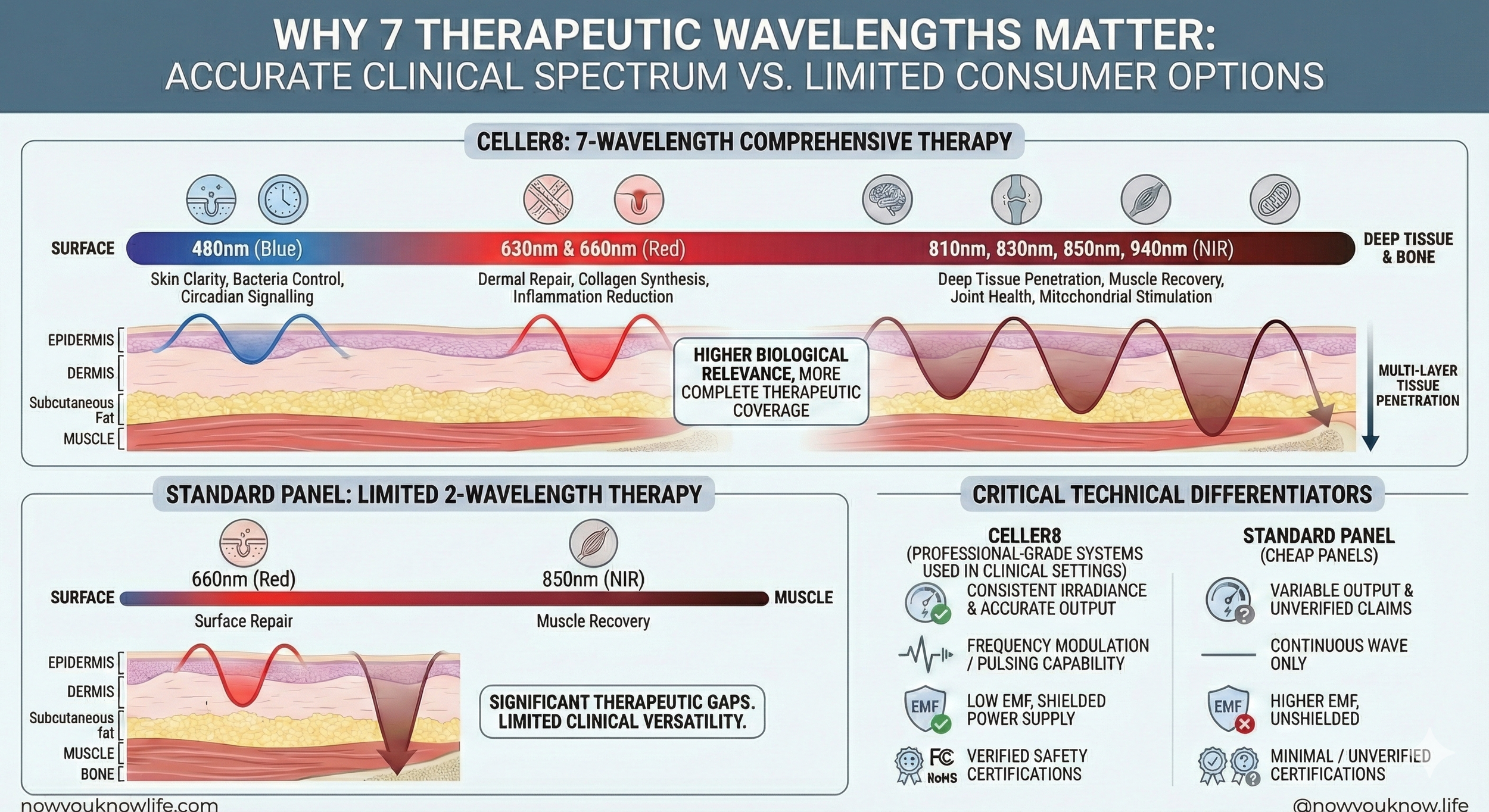
Wavelength penetration guide. [See the 2026 UK panels that actually reach these therapeutic depths].
Checklist 6: Total Cost of Ownership
Initial price rarely reflects long-term cost.
The most common expensive path is replacement.
Lower-quality panels often lead to dissatisfaction, upgrades, and resale losses.
Premium devices, by contrast, tend to remain in use for years, delivering better outcomes and stronger overall value.
Long-term adherence is one of the strongest predictors of therapeutic benefit.
A Simple Decision Framework
If your goal is curiosity and experimentation, an entry-level panel can serve as a low-commitment starting point.
If your goal is recovery, performance, skin health, sleep optimisation, or long-term wellbeing, prioritise consistency, engineering quality, and ownership experience.
The best red light therapy panel UK buyers choose is not the most powerful on paper.
It is the one that delivers stable results, integrates effortlessly into daily life, and continues performing year after year.
Where to Go Next
If you want a deeper breakdown of how panels compare with masks — including performance differences, treatment coverage, and real-world use cases - read the main comparison guide below.