How Far Should You Stand From a Red Light Panel? (Distance, Time & Setup Guide – UK)
By the end of this edit, you’ll know the correct distance for red light therapy and how to use it properly to get real results at home.
Distance is the most overlooked part of red light therapy
It is the reason some people see clear results, while others feel nothing and quietly give up. Not because red light does not work.
Because their setup ruins the dose.
This guide is written for real home use. No lab language. No brand hype. Just what consistently works in normal rooms, with normal schedules, and realistic expectations.
This is not medical advice; always consult a qualified healthcare provider before making changes to your health routine.
Why distance matters more than specs and brands
A red light panel can look impressive on paper and still disappoint in practice. The reason is simple: the useful intensity drops as you move away from the LEDs.
Most people fall into one of two traps.
They stand too far away, so the session becomes weak and inefficient.
Or they stand too close, so the exposure becomes uncomfortable, inconsistent, or counterproductive.
Distance controls intensity.
Intensity controls dose.
Dose controls results.
And because most people do not track dose properly, distance becomes the easiest lever to get right.
The effects of red and near-infrared light depend on the dose delivered to tissue, which is determined by both light intensity at the skin (irradiance) and exposure time, a principle widely described in research by Michael R. Hamblin.
The distance range that works for most people
For most modern home red light panels, a practical working range looks like this:
30 to 60 cm for targeted sessions
45 to 75 cm for broader coverage
Avoid closer than 20 cm unless your panel is low powered or sessions are very short
Avoid beyond 90 cm unless you are deliberately aiming for a gentle, ambient session
If you only remember one thing, make it this: most people should start around 45 cm, then adjust.
Distance by goal, with routines that actually stick
Skin and face
Best distance: 30 to 45 cm
Why it works: even coverage without excess heat or glare
Starting routine: 8 to 10 minutes, 3 to 5 times per week
The most common mistake is pressing right up close, assuming closer means better. In practice, it usually just makes sessions harsher and harder to repeat consistently.
Red and near-infrared wavelengths guide →
Muscle recovery and joints
Best distance: 30 to 60 cm
Why it works: enough intensity without overdoing it
Starting routine: 10 minutes per area, 3 to 5 times per week
If you are treating a specific joint, keep the panel fixed and move your body rather than the device. That keeps exposure consistent.
Full body sessions
Best distance: 45 to 75 cm
Why it works: coverage matters more than peak intensity
Starting routine: 10 to 15 minutes total, 3 to 4 times per week
Trying to treat your whole body from very close range is one of the fastest ways to turn a good panel into a frustrating experience.
Evening use and wind down
Best distance: 60 to 90 cm
Why it works: gentler exposure with less stimulation
Starting routine: 6 to 10 minutes, earlier in the evening, 3 to 5 times per week
If you are sensitive, evening use should feel calming, not activating.
Photobiomodulation follows a dose–response curve, where too little light has no effect and too much can reduce or negate benefits, a pattern consistently described in the work of Michael R. Hamblin and others in the field.
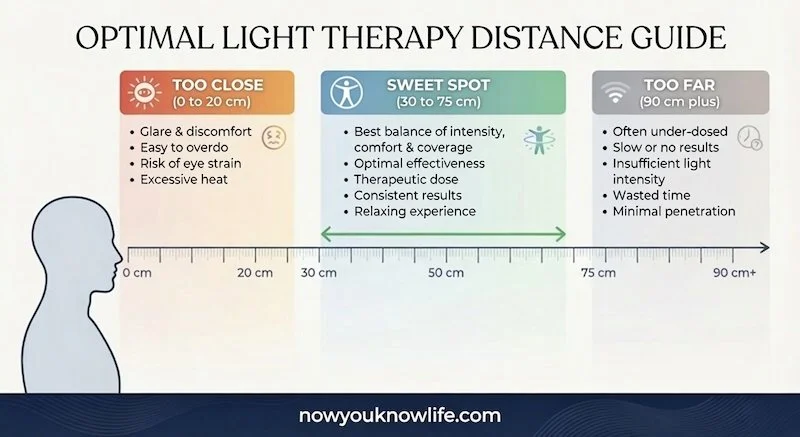
Figure 1: Optimal treatment distances. [See our 2026 UK panel review for devices that perform at these distances]
Why “closer is better” quietly fails
It is tempting to assume that standing closer will deliver faster results. Sometimes it does, briefly.
Then one of a few things happens.
Sessions feel harsh or uncomfortable.
Headaches or overstimulation appear.
Consistency drops.
Results stall or reverse.
The premium approach is not maximum intensity. It is repeatable exposure with a setup you can live with for months.
Consistency wins.
If you want a starting point that works for most people
Place the panel at chest height
Stand 45 cm away
Use it for 10 minutes per area
Repeat 3 to 5 times per week
Adjust distance first, then time if needed
If results feel weak, step slightly closer.
If sessions feel uncomfortable, step slightly back.
Do not jump straight to longer sessions to fix a distance problem.
How to tell if your distance is wrong
You are probably too close if:
The light feels harsh or glaring
You feel wired, overstimulated, or headachy
You start skipping sessions
You are probably too far if:
Nothing changes after two to three weeks.
you keep extending sessions with no effect
full body sessions feel pointless
The right distance feels calm, tolerable, and easy to repeat.
Why this matters when choosing a device
Distance control is one of the reasons panels tend to outperform masks long term. Masks lock you into one distance, usually flush to the skin.
Panels let you adjust intensity simply by stepping forward or back.
That flexibility makes panels easier to personalise and easier to stick with.
The takeaway
Distance is not a minor detail. It is the control dial.
Get it right, and red light therapy becomes predictable.
Get it wrong, and everything else becomes noise.
Start around 45 cm, stay consistent, and adjust distance before changing anything else.