PEMF vs Red Light Therapy: Which Is Better for Recovery in 2026?

Is PEMF or red light therapy better in 2026?
PEMF and red light therapy are often grouped together, but they are not the same thing.
Both are non-invasive recovery technologies, and both are now common in clinics, spas, gyms and high-end home wellness setups.
For muscle recovery after training, red light therapy currently has the stronger direct evidence. For joint stiffness, body aches, evening recovery and sleep routines, PEMF may be the more useful upgrade.
The best choice depends on what kind of recovery you actually need.
What are the main differences between PEMF and red light therapy?
The main difference is the type of stimulus. Red light therapy uses red and near-infrared wavelengths, while PEMF uses pulsed electromagnetic fields.
Red light therapy can be targeted or used over larger body areas. It is often stronger for muscle recovery, skin health and performance-focused routines.
PEMF is usually more passive, often used through a mat or pad. It is better suited to stiffness, body aches, joint discomfort and evening wind-down.
So it is not simply targeted versus whole-body. Red light is light-based and more performance or skin-focused. PEMF is electromagnetic and more recovery, relaxation and stiffness-focused.
The best choice depends on what kind of recovery you need.
PEMF vs red light therapy: the quick verdict
If your main goal is muscle recovery, post-gym soreness, performance support, skin health or collagen support, red light therapy is usually the better first choice.
If your main goal is joint stiffness, back discomfort, evening wind-down, passive full-body recovery or sleep routine support, PEMF may make more sense.
If you want the most complete home recovery setup, the best answer may be both.
They are not direct replacements. Red light supports the active side of recovery, while PEMF supports the restorative side.
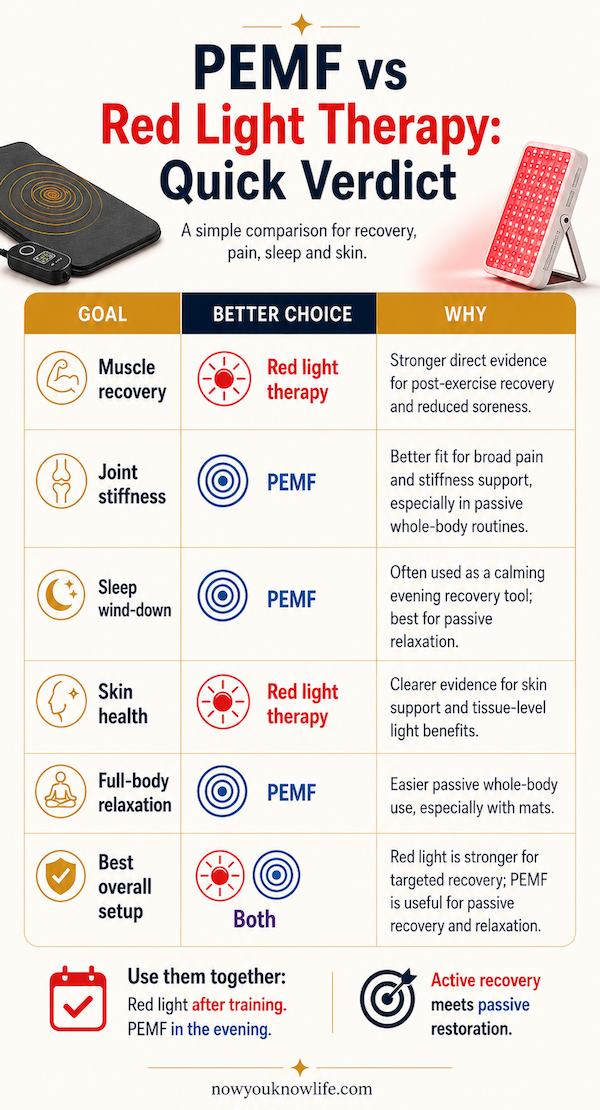
Quick verdict: red light for active recovery, PEMF for passive restoration.
Is red light therapy better than PEMF for muscle recovery?
For muscle recovery, red light therapy has the edge. The evidence is more directly connected to exercise.
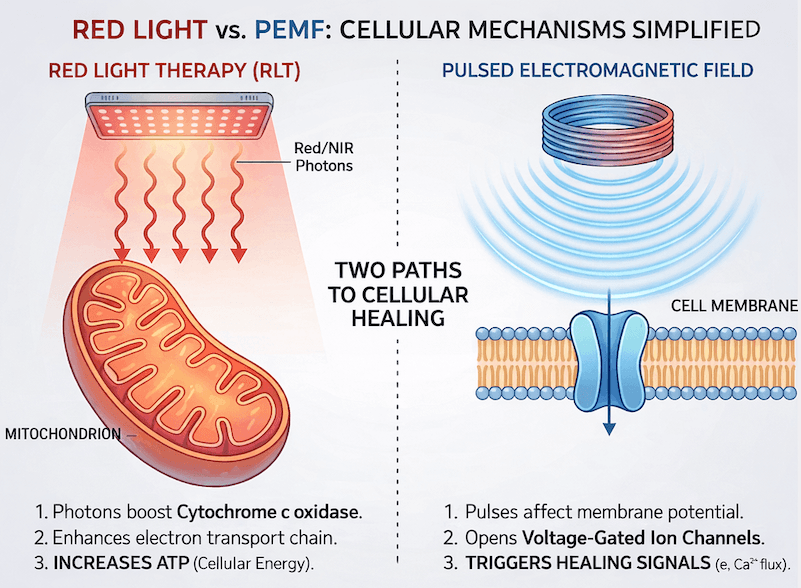
Red light therapy is also known as photobiomodulation. It usually uses red and near-infrared wavelengths, commonly around 630 to 660 nm and 810 to 850 nm.
These wavelengths can interact with light-sensitive structures inside cells, especially in the mitochondria. That is one reason red light therapy is studied for muscle recovery, pain, skin health and tissue repair.
For fitness users, the key question is simple: can it help you recover faster after hard training?
The answer is promising, especially for soreness and strength recovery.
A 2025 systematic review found photomodulation therapy was linked with reduced DOMS-related pain and improved muscle strength recovery compared with placebo (Tsou et al., 2025).
That makes red light therapy the stronger first choice for people who train hard, especially if the main goal is post-workout recovery.
It still needs to be done properly. A weak panel, poor wavelength mix or random session timing may do very little.
Red light therapy is not magic, but for gym recovery, it is currently the more evidence-aligned choice.
If PEMF feels like the missing layer in your recovery routine, read our full buyer’s guide:
Best PEMF Mats UK 2026: How to Choose One That’s Actually Worth It
If you want to add red light therapy to your routine you can see our top recommendation here:
Best red light panel for UK buyers
Is PEMF better than red light therapy for pain and stiffness?
PEMF becomes more interesting when the goal is not just muscle soreness, but stiffness, joint discomfort and deeper body aches.
PEMF stands for pulsed electromagnetic field therapy. Instead of light, PEMF devices deliver low-frequency electromagnetic pulses, usually through mats, pads, loops or wearable devices.
The experience is different from red light. With red light, you sit or stand in front of a panel. With PEMF, you usually lie down and let the session run.
That makes PEMF feel less like a treatment and more like a recovery ritual.
PEMF has been studied in osteoarthritis and musculoskeletal pain, especially around pain, stiffness and physical function.
A 2022 review found PEMF appeared helpful in the short term for pain relief and function in osteoarthritis, although the quality and consistency of evidence varies (Markovic et al., 2022).
That nuance matters. PEMF has promise, but not every device, protocol or claim deserves the same level of trust.
Still, for someone dealing with stiffness, knee discomfort, back tightness or general aches, PEMF may feel more useful than red light alone.
Red light can also support pain and inflammation. But if the issue feels deeper, more joint-related or more whole-body, PEMF may be the more natural tool to consider.
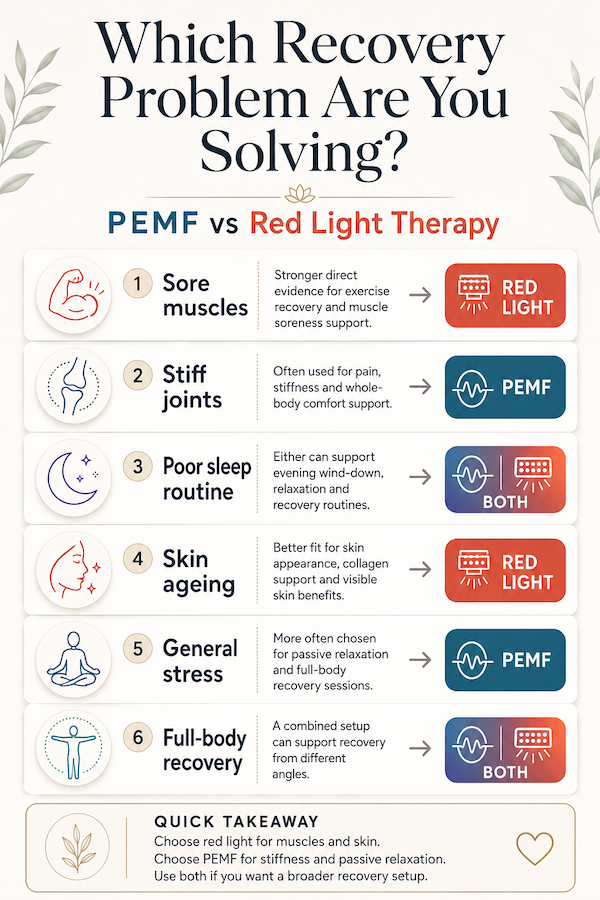
Decision chart comparing PEMF vs red light therapy for recovery goals including sore muscles, stiff joints, sleep, skin ageing, stress and full-body recovery.
Is PEMF or red light therapy better for sleep?
PEMF is usually the better fit for sleep routines.
Not because it is a sleeping pill. It isn’t.
The reason is simpler: the format works beautifully for evening use. You lie down, stop scrolling, lower stimulation and build a repeatable recovery ritual.
That alone has value. Some people also find low-intensity PEMF sessions calming, especially when used in the evening.
The research here is not as strong as it is for established sleep interventions. But from a lifestyle perspective, PEMF is easy to place before bed.
Red light therapy can also fit into an evening routine, but bright panels may feel stimulating for some people, especially late at night.
For sleep, red light is better thought of as part of a light-hygiene strategy. PEMF is better thought of as a wind-down tool.
If your sleep is poor, start with the basics first: room temperature, light exposure, consistent timing and caffeine control. Then consider PEMF as a premium recovery layer.
Is red light therapy or PEMF better for skin and visible ageing?
Red light therapy wins this category clearly.
This is not PEMF’s strongest lane.
Red light therapy is widely used for skin quality, collagen support, redness, texture and visible ageing. That makes it more versatile for people who want one device with both recovery and aesthetic benefits.
A good red light panel can be used for muscle recovery, skin health, general wellness and targeted pain. That versatility is why red light panels have become so popular.
PEMF is less visual. You do not buy a PEMF mat because you want your skin to look better in six weeks.
You buy it because you want to feel better.
That is a very different promise.
Can you use PEMF and red light therapy together?
Yes. In many cases, they make more sense together than as a choice between one or the other.
Red light therapy is better suited to targeted recovery, especially after training or on areas that feel sore, tight or overworked.
PEMF is better suited to passive recovery, where the goal is to lie down, relax and support whole-body comfort.
A simple routine could look like this: red light after training, PEMF in the evening.
That way, red light supports the more active side of recovery, while PEMF supports the restorative side. Used together, they can create a more complete home recovery routine without making the process complicated.
PEMF vs red light therapy: which should you buy first?
If you train hard and want better muscle recovery, buy red light first. It is more directly aligned with exercise recovery and it is also more versatile because it can support skin health.
If you already own red light, PEMF is a strong second upgrade, especially if you struggle with stiffness, poor recovery, stress, aches or evening restlessness.
If your goal is luxury home recovery rather than just performance, PEMF becomes more interesting. It is not the obvious first purchase for everyone, but it may be the more elegant long-term habit.
For most people, the order looks like this: red light panel first, PEMF mat second, then sauna, cold exposure or compression later.
That gives you a strong recovery base without turning your home into a clinic.
If PEMF feels like the missing layer in your recovery routine, read our full buyer’s guide:
Best PEMF Mats UK 2026: How to Choose One That’s Actually Worth It
What to look for before buying PEMF or red light therapy
For red light therapy, look for red and near-infrared wavelengths, clear irradiance data, good coverage area, low flicker, low EMF testing, a sensible warranty and transparent specifications.
For PEMF, look for clear frequency settings, low-intensity options, comfortable full-body design, simple controls, transparent specifications, strong warranty and returns.
Avoid vague “energy healing” language. Avoid brands that hide basic specs. Avoid any company that promises guaranteed medical outcomes.
In premium wellness, credibility is part of the product. A device should look good, feel good and explain itself properly.
Is PEMF or red light therapy safe?
Red light therapy and PEMF are both generally positioned as non-invasive wellness technologies, but they are not suitable for everyone.
Be more cautious with PEMF if you are pregnant, have a pacemaker, implanted electronic device, active implanted medical hardware or a serious heart rhythm condition.
Be more cautious with red light therapy if you have light-sensitive conditions, take photosensitising medication or have been told to avoid intense light exposure.
When in doubt, ask a clinician, especially if you are using either technology for pain, injury or a diagnosed condition. Wellness tools can be useful, but they are not a replacement for medical assessment.
Final verdict: PEMF vs red light therapy
Red light therapy is the better first choice for muscle recovery, performance support and skin benefits.
PEMF is the better choice for passive recovery, joint stiffness, evening wind-down and whole-body comfort.
If you only care about post-workout soreness, choose red light. If you feel stiff, stressed, sore and under-recovered, consider PEMF.
If you want the strongest home recovery setup, use both.
Red light supports the active side of recovery. PEMF supports the restorative side.
That is the real difference. Not which technology sounds more advanced, but which one fits the recovery problem you actually have.
Read more cellular health articles here.
Now you know.
© 2026 nowyouknowlife.com All rights reserved